



Looking for a new job can be overwhelming and time-consuming. Here are some ways you can make your search more successful:

Main Content Area
Looking for a new job can be overwhelming and time-consuming. Here are some ways you can make your search more successful:
AI is a support tool — not a replacement for thinking about how your skills and experiences tell your unique story to an employer.
When in doubt, choose authenticity. Employers value honesty.
Yes, but only as a starting point, never as the final product. You should always revise the content so it reflects your real experience, skills, and voice. Fully AI-written documents will hurt you in the job search, as employers are interested in who you are, not the “voice” of AI.
Yes. AI can help you practice questions and organize responses. Make sure your answers are honest and based on your actual experience. AI can help you generate industry- and position-specific questions that you may be asked. Never use AI to answer your interview questions–remember, AI cannot tell your story for you!
Employers may notice if content sounds generic or doesn’t match your background. Clear, specific, and authentic documents stand out more than polished but vague ones.
AI can suggest options, but career decisions should include reflection and human guidance. Career Services staff can help you explore choices in depth.
Career Services views AI as a tool — not cheating — when used responsibly. Misrepresentation or fabrication is never appropriate.
Ask a Career Advisor. We’re here to help.
Many employers use AI in hiring and the workplace, and they expect candidates to:
Using AI well is a career skill — using it carelessly can hurt your chances.
Use short, clear prompts like these. Always review and revise the results so they reflect your real experience.
"Here is my resume and the job description. Help me improve clarity and wording without adding skills or experience I don’t have."
"Using my experience below and this job posting, help me draft a professional cover letter. Ask questions if you need more details."
"Act as an interviewer for this job. Ask me one question at a time and give brief feedback after each answer."
Bad Prompt (Don’t Use):
"Write me a perfect resume for this job."
Why it’s a problem: This can lead to generic content or made-up experience.
Better Prompt:
"Here is my resume and the job description. Help me rephrase my existing experience to better match this role without adding anything new."
Why it works: It keeps the content accurate, specific, and authentic.
Career Services can help you:
AI works best when paired with your judgment and human support.
If you have a career goal in mind and are just looking for a short-term job, why not look for positions that will give you valuable experience and set you up to reach your career goal? Look for positions that use some of the same skills your career goal requires, are in a company related to your career goal, or put you in close contact with people who are already working in that career.
Use synonyms of your terms to broaden the results. Sometimes the same position will go by multiple titles, so play around with your search terms to find the whole scope of available positions. If you aren’t sure what other titles to search for, you can view alternative position titles at My Next Move.
You can also search generic relevant terms like "math" or "customer service" or search skills you've already mastered to discover jobs that use that skill. Databases will often match your search using terms found in job descriptions, not just the title.
Before you apply to a company, make sure you check out the "Values," "Mission," "Purpose" or "Goals" web pages. This will give you more information about how the company might suit you and help you develop your cover letter.
If you’re interested in a specific company, you can search for jobs directly on its website. Most company websites have a "Career," "Jobs," or "Employment Opportunities" section at the top or bottom of the homepage where they post open positions. Applying on the company's site is also generally a good idea to avoid any potential scam job postings.
Job fairs are a great way to connect with potential employers, learn about companies in your field that are hiring, gain experience networking and maybe even find the right job for you. With a little preparation, you can make a great first impression.
Here are some ways to get ready:
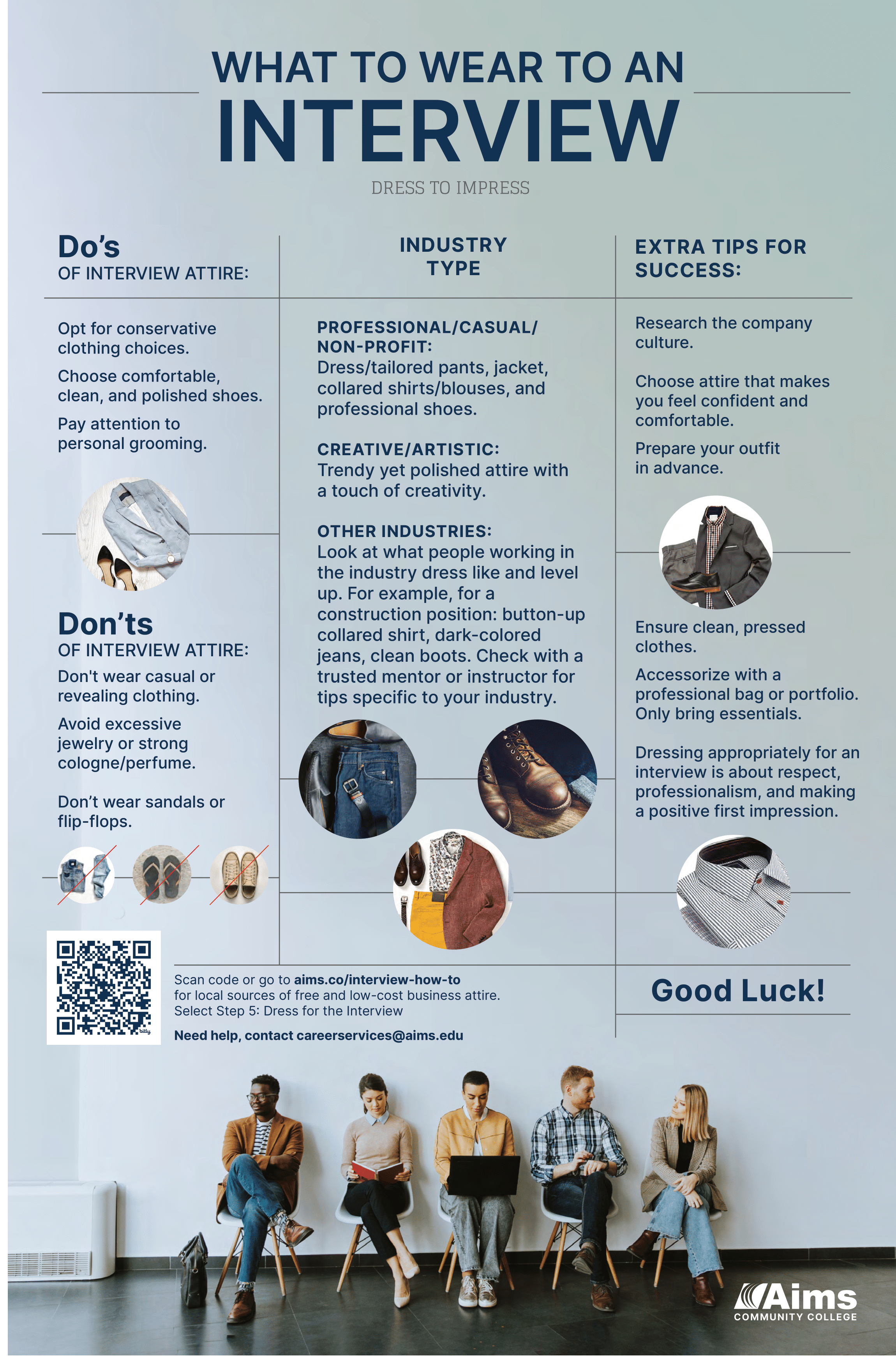
Download and print the What To Wear To An Interview graphic.
Local sources for free and low-cost business attire:
Arc Thrift Store
Goodwill of Colorado
Plato’s Closet Thrift Store
The presence or posting of job announcements on any website, including the Aims Student Job Board powered by Handshake and maintained by Career Services, should not be interpreted as an endorsement or recommendation by Aims Community College or Career Services.
Students and alumni are urged to exercise caution and diligence when pursuing internships or employment opportunities and to verify the credentials and integrity of employers or organizations. Career Services resources are offered at no cost to both employers and students/alumni seeking job opportunities. All matters concerning hiring and compensation for work are dealt with directly between the student/alumnus and the employer.
Career Services does not conduct background checks on students/alumni applying for jobs or on employers posting job openings. Both employers and students/alumni are encouraged to request and provide reference information to establish qualifications, credentials, and suitability for the position.
Career Services does not guarantee or vouch for the positions posted through their office and cannot be held accountable for safety, wages, working conditions or any other aspects of off-campus employment. Students are strongly advised to thoroughly research employers when applying for or accepting off-campus employment. Career Services staff members are available to offer guidance on researching prospective employers. Click here to schedule an appointment today!