


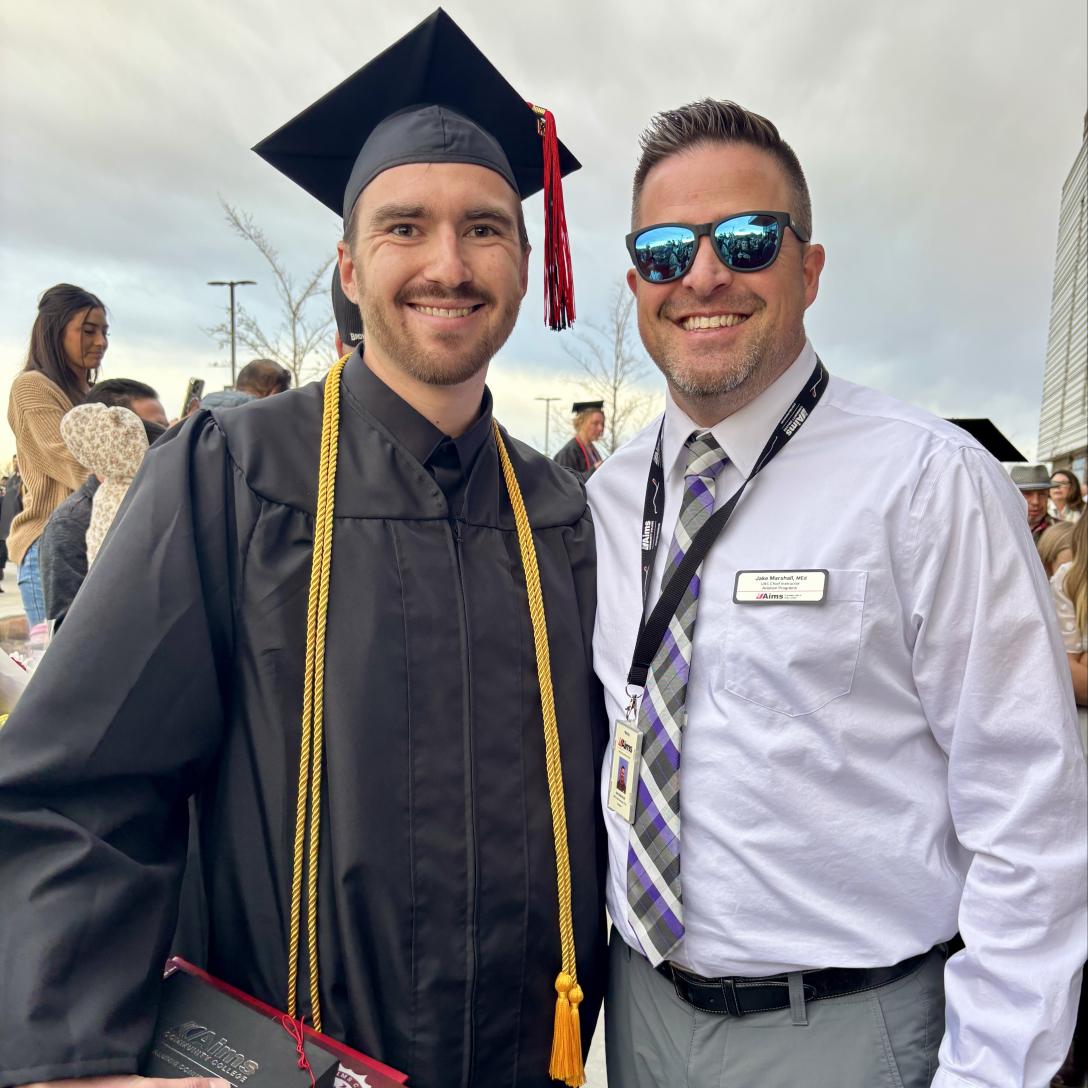
When Ben Marushack graduated from Aims Community College in Fall 2024 with a degree in Air Traffic Control, he was already on the path to his dream career.

Main Content Area
When Ben Marushack graduated from Aims Community College in Fall 2024 with a degree in Air Traffic Control, he was already on the path to his dream career.
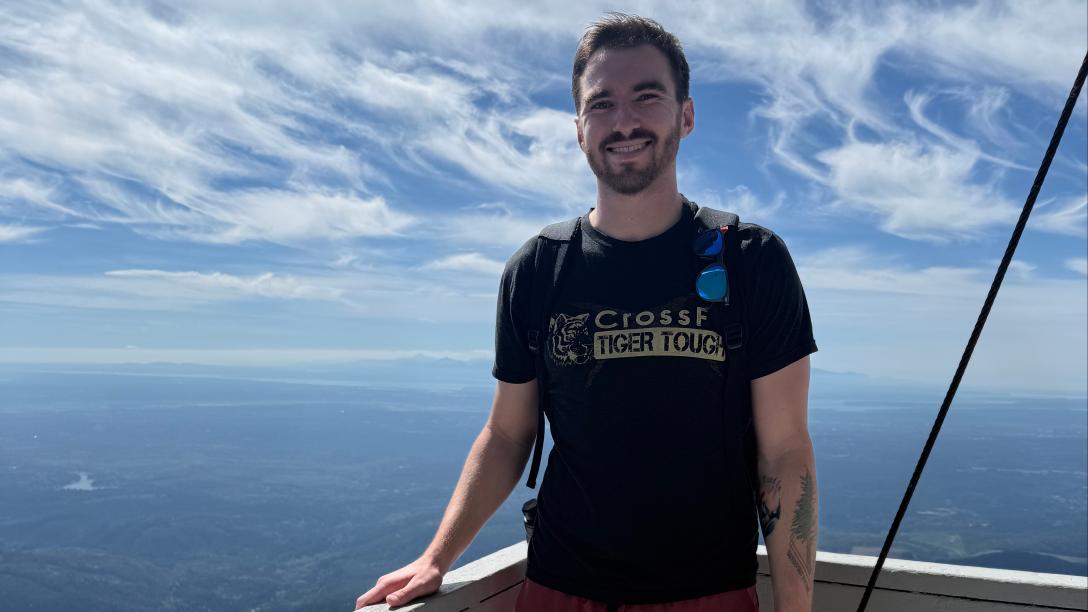
Today, Ben is working as an Air Traffic Controller at Paine Field Airport in Everett, Washington. Paine Field is a medium-sized, multi-use public airport that combines general aviation, commercial passenger flights and significant aerospace industry activity in one location. He genuinely enjoys being there. Ben describes the scenery as fantastic and says the view from the control tower is considered one of the best in the country. From the control tower, he can see the Puget Sound and the Olympic Mountains to the west, the Seattle skyline to the south and the North Cascades to the east. In his words, “the view is nothing else.”
For Ben, being a good air traffic controller isn’t about memorizing rules; it’s about how you think under pressure. He describes the job as a never-ending puzzle. A strong controller, he says, must think on their feet, adapt quickly when conditions shift, and stay focused in a high-intensity environment. Equally important is the ability to accept constructive feedback and learn quickly, because the stakes are high and the learning process never truly stops. It’s a role that demands logic, flexibility and composure. This is precisely the environment Ben thrives in.

The path to get him here was a long road, but Ben accepted the challenge. He grew up in Cañon City, Colorado. His first career ambition had nothing to do with aviation. “Coming out of high school, I wanted to pursue a career in golf as a golf instructor,” he said. “I went down that road for a couple of years before realizing it wasn’t what I wanted long-term.”
That realization led Ben to look toward the sky. He was fascinated by aviation but knew early on that being a pilot wasn’t his path. “I figured I didn’t want to fly for a living. That’s when I decided to take a career in air traffic control,” he explained.
Ben’s launchpad in the industry came from Aims and the Air Traffic Control associate degree. “All of my instructors were retired controllers,” Ben said. “They knew how the job worked, what the environment was like and they prepared us for exactly what to expect.” He recalls instructor Barry Dishman, whose advice stayed with him: school teaches memorization; air traffic control teaches thinking. That philosophy shaped his approach to training and learning.
Dishman thought that Ben was an absolute joy to have as a student. “Ben was a smart, kind and highly inquisitive student. Always determined to be successful in everything he approached, especially if it related to aviation.”
Through teachers and peers, Ben also found a sense of belonging at Aims. "You walk in the door and you don’t feel like a number,” he said. “People know your name. I made a couple of my closest friends during my time at Aims.”
As a student, Ben explored other aspects of aviation, such as joining the Unmanned Aerial Systems (UAS) Operations Team. “We had a lot of fun doing what we do, flying drones, shooting Toyota commercials and gaining real-world experience with top-of-the-line equipment,” he said. One of the projects included building a Honda STOL (Short Takeoff and Landing) concept aircraft.
While still in school, Ben applied to the Federal Aviation Administration (FAA) Academy in March 2024, during the national application window. As his application was being processed, he completed his final semesters at Aims and graduated in December 2024.
The following spring, Ben attended the FAA Academy in Oklahoma City. It is a high-stakes environment as people only get one chance to get it right. “It’s kind of a one-and-done situation,” he said. “If you don’t pass, there’s not really a second chance.”
Ben came to Aims with no aviation experience and it laid the foundation for his success. The FAA Academy lasts approximately three months and is divided into academic and hands-on simulation components. “The equipment we trained on at Aims was almost a mirror image of what they use at the FAA Academy,” he said. “It made the transition seamless when everything was on the line.”
Ben passed the FAA’s Air Traffic Skills Assessment (ATSA) later that summer. After the test comes a long stretch of waiting, followed by federal screening that includes a medical examination, a comprehensive background investigation and fingerprinting. He describes this part as uncertain and mentally taxing because there’s very little feedback while you wait.
Near the end of the Academy, candidates receive a list of facility placements. The FAA provides a list of available facilities nationwide and candidates select from that list. Placement depends on availability, staffing needs and performance. He chose Paine Field and started working there in June 2025.

After placement, training is not over. Controllers undergo on-site training at their assigned facility, typically for one to several years, depending on the complexity and progress. The key thing Ben emphasizes is that the FAA process rewards preparation, patience and focus.
“My time at Aims allowed me to not only be successful at the FAA Academy, but to start my career with confidence,” he said. Now working in the industry, Ben looks back with gratitude for the aviation program that played into his success. “I can’t imagine how hard the road would’ve been without Aims,” he said. “I tell my dad’s high school students all the time. If you’re interested in aviation, check out Aims. It’s a great experience all around.”