

Frank Garza’s artwork can be seen throughout the Front Range. But long before his murals and sculptures became landmarks, Garza was an Aims Community College student discovering that he could turn a lifelong passion into a profession.

Main Content Area
Frank Garza’s artwork can be seen throughout the Front Range. But long before his murals and sculptures became landmarks, Garza was an Aims Community College student discovering that he could turn a lifelong passion into a profession.
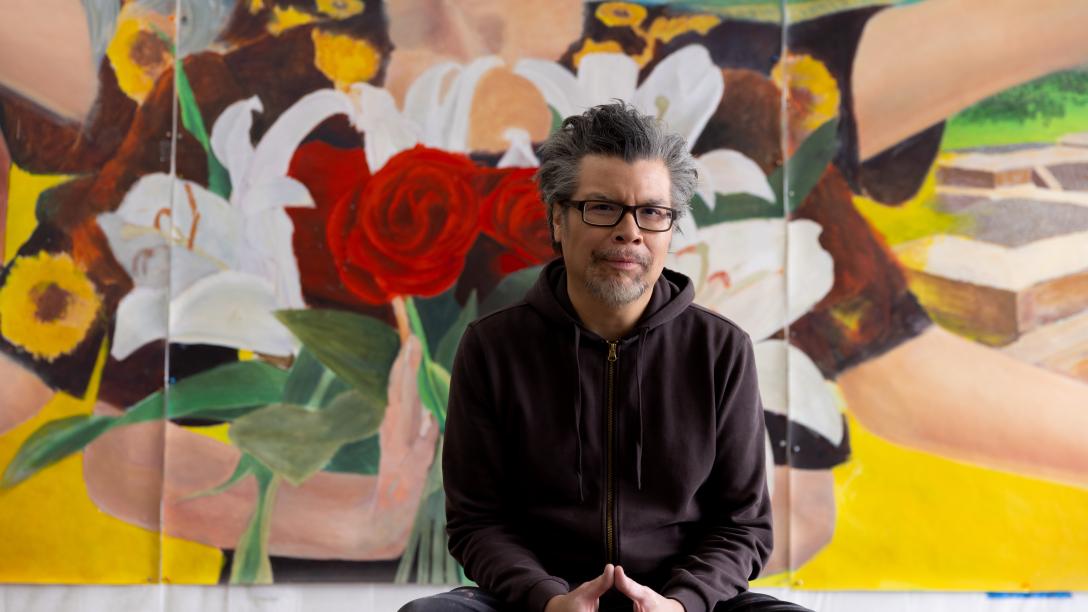
Frank graduated from Aims in the mid-90s with an Associate of Arts degree in Visual Art.
He has always been interested in art, but also fascinated by music, mathematics and philosophy. As a kid, he doodled constantly. It was something his teachers recognized early. “I was always drawing,” he said. “Teachers would send notes home about it.”
Those messages never quite landed. His mother, raising him and his sister on her own, had her own reasons for keeping that path at a distance. Her brother, an aspiring artist, had died in a car accident before Frank was born. “She didn’t want that path for me,” he said. “She was protecting me. I just didn’t understand it at the time.”
So, he learned to keep art in the background. Frank poured his energy into music instead, studying guitar and theory and imagining a future built around sound. Art classes became something familiar, easy, but not central. “I took them because they were the easy A’s,” he said with a laugh.
As a high school student, Frank was already looking beyond the traditional classroom. Drawn to learning opportunities wherever he could find them, he began taking classes at Aims while still in high school. After a few classes, he was hooked. When he arrived at Aims, he found faculty who encouraged curiosity rather than forcing students into a single path.
He credits instructors, including art professor Tedd Runge and logic professor Dr. Russ Ward, with shaping his outlook (both are now retired). Ward’s classes were especially influential. “He challenged the way I thought,” Frank recalls. The courses were so impactful that he briefly considered becoming a philosophy professor himself.
At the same time, the Aims art community was opening new doors. For the first time, Frank found himself surrounded by artists who were actively making work and instructors who treated art as a profession.
"At Aims, you’re around people who are in the midst of accomplishing their dreams. It’s not theoretical; it’s happening all around you.”
Up to that point, art had always been a part of his life, but he had never fully embraced it. The artistic community at Aims exposed him to what it looked like to live and work as an artist. Students collaborated, instructors were actively creating and opportunities extended beyond the classroom walls.
“You start to see that this is something you can actually do,” he said. “Not just study but do.”
After transferring to the University of Northern Colorado, Frank continued to develop his artistic skills. At UNC, he also discovered something important about the kind of artist he wanted to become. Much of the coursework emphasized smaller-scale projects, and his ambitions were on a larger scale. “I remember getting frustrated having to work small,” he recalled.
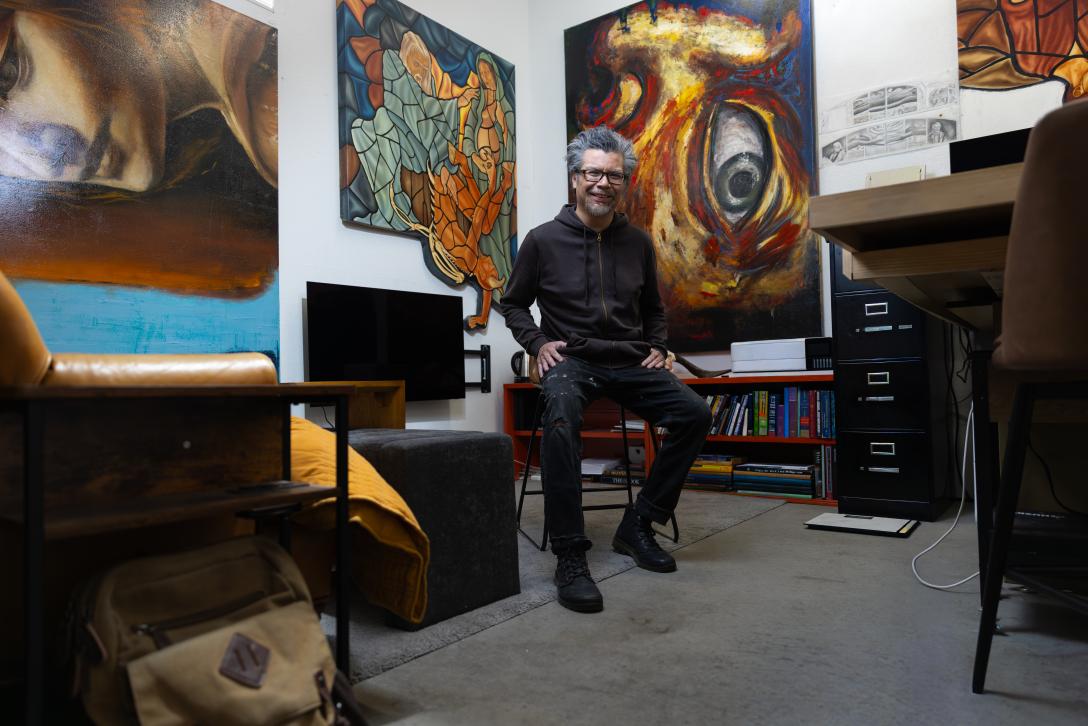
While many students were focused on creating gallery work, Frank was increasingly interested in work that could occupy entire walls, transform buildings or become part of a public space. He was drawn to the challenges that came with large-scale work; the planning, problem-solving and collaboration needed to bring ambitious ideas to life. He enjoyed thinking about how artwork interacted with architecture and how people would experience it as they moved through a space.
Looking back, those frustrations in the studio were early clues about the direction his career would take. Rather than pursuing a traditional gallery path, Frank would go on to create murals, installations and public artworks throughout Colorado, developing a reputation for pieces that are integrated into the places they inhabit.
One of Frank’s first large projects was an apprenticeship at the University of Northern Colorado, Candelaria Hall mural with celebrated Chicano muralist Leo Tanguma. “Working with Leo was an incredible learning experience,” Frank said. Working on the mural, “The Life and Times of Dr. Martin Candelaria,” gave Frank technical training and the opportunity to work on a project that reflects a community’s history, culture and aspirations.
Around this same time, Frank found out that he was going to be a father. “Before I realized I would be a public artist, I learned I was going to be a dad,” he said. His daughter Lily was born in 2000 and became one of his artistic muses.
“I’ve painted her in most of my murals when it seemed appropriate for the theme,” Frank admitted. “I painted her as a creative, a role model, an intellectual, a leader, on many of the walls you see throughout the Front Range as one. She inspired me and motivated me to pursue heights I didn’t realize were attainable.”
This was one of the ways Frank wanted to leave a legacy. “Committing to become a professional artist was very risky. I could live the rest of my life and end up completely penniless,” he admitted. “If I never have the means to attain and transfer property and wealth and all the things we all strive to do for our kids. I could at least leave her with a sort of larger-than-life timeline or scrapbook of my daughter painted on various walls around Colorado and hopefully beyond.”
After thoughtful consideration, Frank decided to be a professional artist, despite the risks. After a few years, Frank began contributing to the public art in Greeley and beyond, including “A Visual Resonance “at the Greeley History Museum, “Parchment” at City Center South and “Spectrum” woven into the downtown archways. He has also designed murals for the High Plains Library District, including “Pursuing Longevity” at the LINC Library Innovation Center.
In addition to murals, Frank creates three-dimensional art objects for public spaces, including the sculpture “The Hand That Feeds” at Sugar Beet Park in Fort Collins.
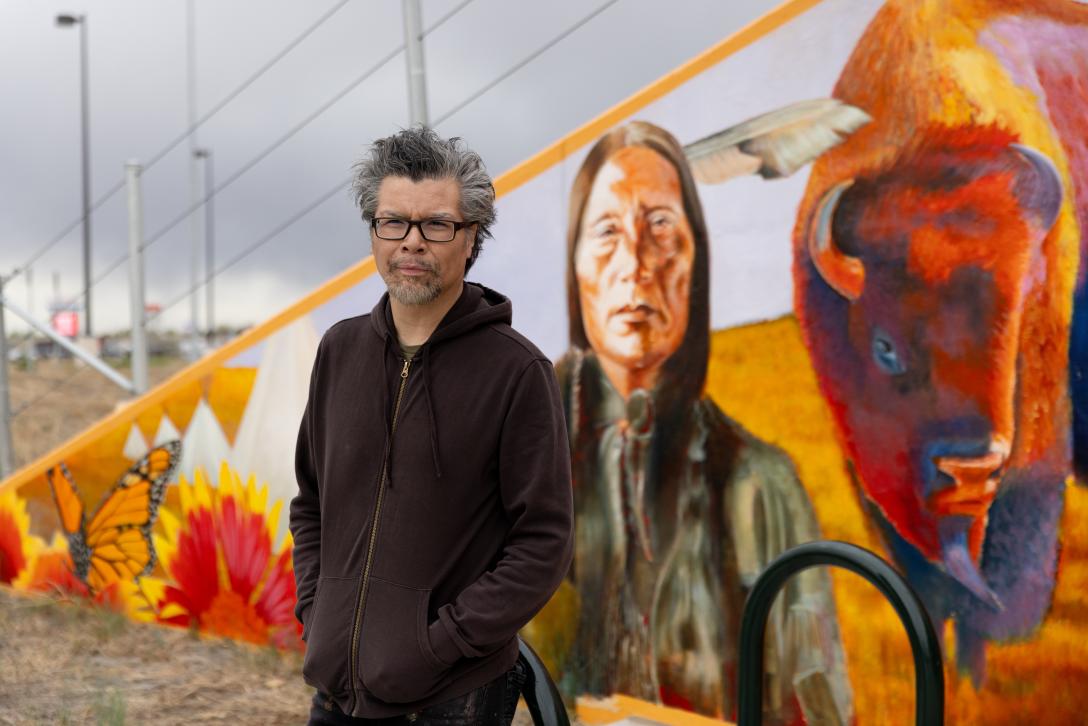
His work extends further south to the Denver area, including “No Shoes Too Big” at the Elbra M. Wedgeworth Municipal Building and “Maintaining our Future” at the Infrastructure and Maintenance Center in Thornton. Frank’s most recent mural, “Connectivity,” is at the Firestone-Longmont Mobility Hub along I-25.
As he continues to evolve, Frank approaches each project as an opportunity to listen to a place, understand its story and create something lasting for the people who move through it.